Does Outplacement Improve Employee Engagement? Here’s What the Data Shows
Publication date: Nov 09Engagement doesn’t just dip after a layoff. It can take years to recover, unless something changes the trajectory.
Engagement surveys tend to get quiet after a layoff. Not because HR stops running them, but because the numbers usually aren’t good, and there’s a natural instinct to wait for things to settle before looking too closely. The research suggests that instinct costs time the recovery can’t really afford to lose.
KEY TAKEAWAYS
- Research tracking 146 companies found engagement metrics like company confidence and belief in career opportunities took 12 to 24 months to recover after a layoff.
- The companies with the highest pre-layoff engagement saw the steepest post-layoff declines, an irony worth planning around.
- Engagement recovery correlates closely with how the transition itself was handled, not simply with the passage of time.
- A visible, well-run outplacement program is one of the most concrete, observable actions a company can take during that recovery window.
How Long Engagement Actually Takes to Recover
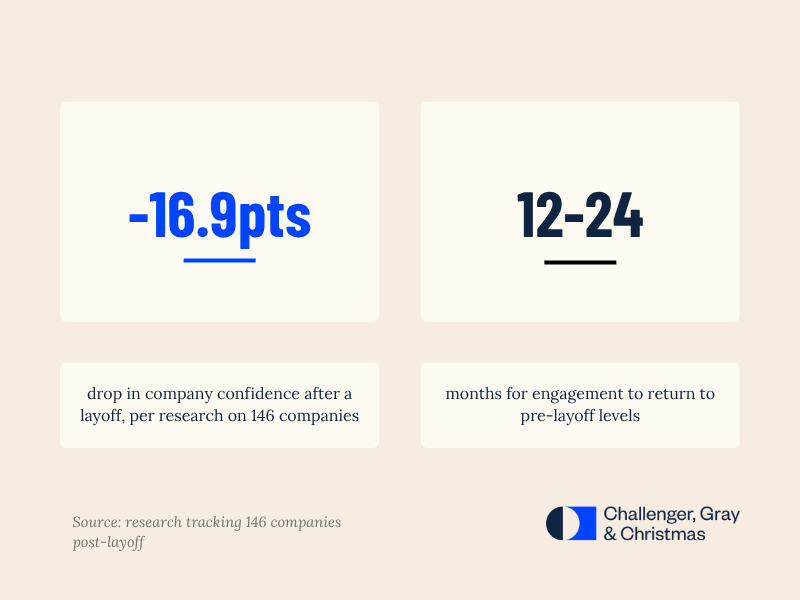
An analysis of 146 companies that conducted layoffs found measurable, lasting damage across several engagement dimensions: company confidence dropped by nearly 17 percentage points, belief in career opportunities fell by roughly 12 points, and confidence in leadership dropped by about 10 points. Recovery to pre-layoff levels took twelve to twenty-four months across the companies studied.
That’s a strikingly long window for a metric most companies treat as a quarterly check-in item. It means the engagement cost of a layoff isn’t really a moment, it’s a multi-year drag on the exact things, confidence, ambition, trust in leadership, that most influence discretionary effort, retention, and ultimately the morale of the whole organization.
The Irony for High-Engagement Cultures
The same research found that companies with the strongest engagement scores before a layoff saw the steepest declines afterward. That’s a hard result for well-run organizations to hear, but it makes sense: the gap between what employees expected and what they experienced was simply larger, which made the drop feel more severe by comparison. It’s a reason to take post-layoff engagement seriously even, or especially, at companies with a strong culture going in, precisely the companies that care most about getting this right.
Engagement doesn't recover because time passes. It recovers because employees see evidence the company is still worth investing their time and career in, and that they are still at a place they feel safe and can trust.
What Actually Moves the Recovery Timeline
Passive time isn’t what shortens this window in the research. What correlates with faster recovery is visible, concrete action: transparent communication about what happened and why, a clear path forward for the business, and demonstrable care for the people who were let go. Remaining employees are, in effect, looking for proof that the company’s stated values held up under pressure, not just during the good times.
A structured outplacement program is one of the clearest, most observable forms that proof can take. It’s not a memo about company values, it’s tangible support that colleagues can see happening in real time: coaching, job search resources, a genuine investment in what comes next for the people leaving. They see their former colleagues progressing in their search, finding new roles, and overall having a path forward. That kind of visible action does more to rebuild confidence in leadership than any follow-up town hall, precisely because it’s a demonstration, not a statement.
Why This Isn't About Optics
It’s worth distinguishing this from simply communicating well about the layoff, sending a thoughtful memo or hosting a town hall. Those things matter, but they’re words. What the research points toward is that employees weigh actions much more heavily than messaging when deciding whether to trust leadership again. An outplacement program is, functionally, an action: resources committed, coaching delivered, real support extended to real people, and remaining employees can tell the difference between a described commitment and a visible one.
This is also why timing matters. Engagement recovery research suggests the trust-rebuilding window opens immediately after the announcement, which means the transition program needs to be visible from day one, not rolled out gradually or treated as a detail to finalize after the fact. Companies that plan the outplacement program alongside the announcement itself, rather than after it, tend to get more out of this recovery benefit, simply because the evidence employees are looking for shows up while they’re still forming their judgment.
There’s a simple way to frame this internally that tends to land well with leadership: most organizations already invest heavily in onboarding, a new hire’s first ninety days, because everyone accepts that a good first experience shapes years of retention and engagement. Offboarding deserves the same weight. It’s the experience your entire remaining workforce is watching in real time, and treating it as an afterthought while treating onboarding as a strategic priority is an inconsistency employees notice, even if leadership doesn’t name it that way.
What This Means for the Business Case, Not Just the Culture Case
Engagement isn’t only a culture metric. Disengaged teams make more errors, take longer to decide, and produce less discretionary effort, exactly the kind of soft costs that are hard to isolate on a P&L but very real in aggregate over a two-year recovery window. Treating engagement recovery as a financial planning question, not just an HR wellness question, is part of what makes the case for a visible transition program land with leadership, not just with HR.
Treating This as Part of Recovery, Not Just Departure
Most companies plan the layoff itself carefully and then treat everything after as a wait-and-see period. Given how long the research says engagement actually takes to recover, that’s a significant amount of time to leave to chance. Building a visible transition program into the plan from the start, and continuing to communicate about it after the announcement, is one of the more direct ways to influence a recovery timeline that otherwise runs on its own for up to two years. We’ve helped thousands of organizations build exactly this kind of communication plan, and our calculator can help you understand the broader return alongside it, so the case for acting early is backed by your own numbers, not just goodwill.
See the ROI of outplacement for your company
Want to shorten your organization’s engagement recovery window? Run your numbers through our calculator for a personalized report, and let’s talk about building a visible transition program into your plan.