How CHROs Earn Credibility by Speaking CFO Language
Publication date: Nov 02
Financial fluency isn’t about becoming an accountant. It’s about becoming an indispensable executive partner.
There is a version of every HR budget meeting where the CHRO walks in prepared, speaks with authority, and leaves with approval. And there is another version where the same CHRO walks in equally prepared, equally committed, and walks out with a smaller number or a ‘let’s revisit this in Q3.
The difference rarely comes down to the quality of the program. It comes down to the language being used to describe it.
KEY TAKEAWAYS
Executive credibility is built through financial fluency, not louder advocacy or more passionate requests.
CFO language reframes HR initiatives as business investments with measurable risk offset — not departmental spend.
Specific phrases tested with real CFOs signal partnership and significantly accelerate budget alignment.
The most influential CHROs connect people decisions to P&L outcomes before they’re asked to make that connection.
Financial fluency changes how HR is perceived across the entire C-suite, not just in the Finance relationship.
What CFO Language Actually Sounds Like in Practice
Consider the difference between these two framings:
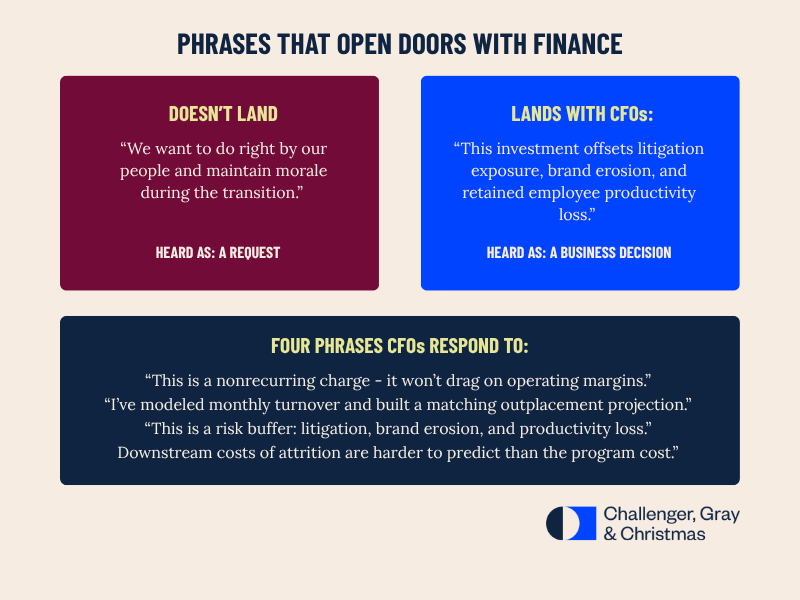
‘We want to do right by our people and maintain morale during the transition.’
‘This investment offsets litigation exposure, employer brand erosion, and retained employee productivity loss — all measurable P&L risks. The program cost is lower than the documented downstream cost of not having it.’
Both are true. Both reflect genuine conviction. But only the second answers the questions running through the CFO’s mind: What risk does this offset? How does it flow through the financials? What’s the ROI case?
The Phrases That Open Doors with Finance
In building our CHRO’s outplacement budgeting guide, we interviewed CFOs across a range of company sizes. Their feedback was remarkably consistent:
“Because this is a restructuring, we can include outplacement in the nonrecurring charges — it won’t drag on our ongoing operating margins.”
“I’ve modeled monthly involuntary turnover and built a matching outplacement projection to smooth cost exposure.”
“This is a risk buffer. It mitigates litigation exposure, employer brand erosion, and productivity loss among retained staff — all measurable.”
“A well-run program reduces downstream costs of attrition and disengagement that are far harder to predict than the program cost itself.”
“HR doesn’t need a louder voice in the budget meeting. It needs a more fluent one.”
— Challenger, Gray & Christmas CFO Research
How Financial Fluency Extends Beyond the Budget Meeting
When CHROs demonstrate that they understand how people decisions flow through the P&L, the benefit extends well beyond any single budget approval. Finance sees HR as a strategic partner whose input is sought before the financial plan is set.
Outplacement gets built into offboarding and restructuring plans from the start, not bolted on afterward. Budget is secured before involuntary separations or the workforce reduction, not scrambled for in the days after.
The Compounding Benefit of Speaking Finance’s Language
The first time you walk into a CFO budget conversation with a cost model instead of just a conviction, something else happens in parallel. Finance notices. The CHROs who make this shift consistently describe a gradual but meaningful change in how they’re engaged across the organization.
That positioning change is worth more than any single budget approval.
The bottom line
The fastest path to C-suite influence isn’t louder advocacy. It’s clearer translation. When HR leaders express the business value of workforce investments in financial terms, the conversation changes, the trust deepens, and the budget follows.