CEO Turnover Falls in September; Women Gains Climb to 27.9%
Publication date: Oct 27
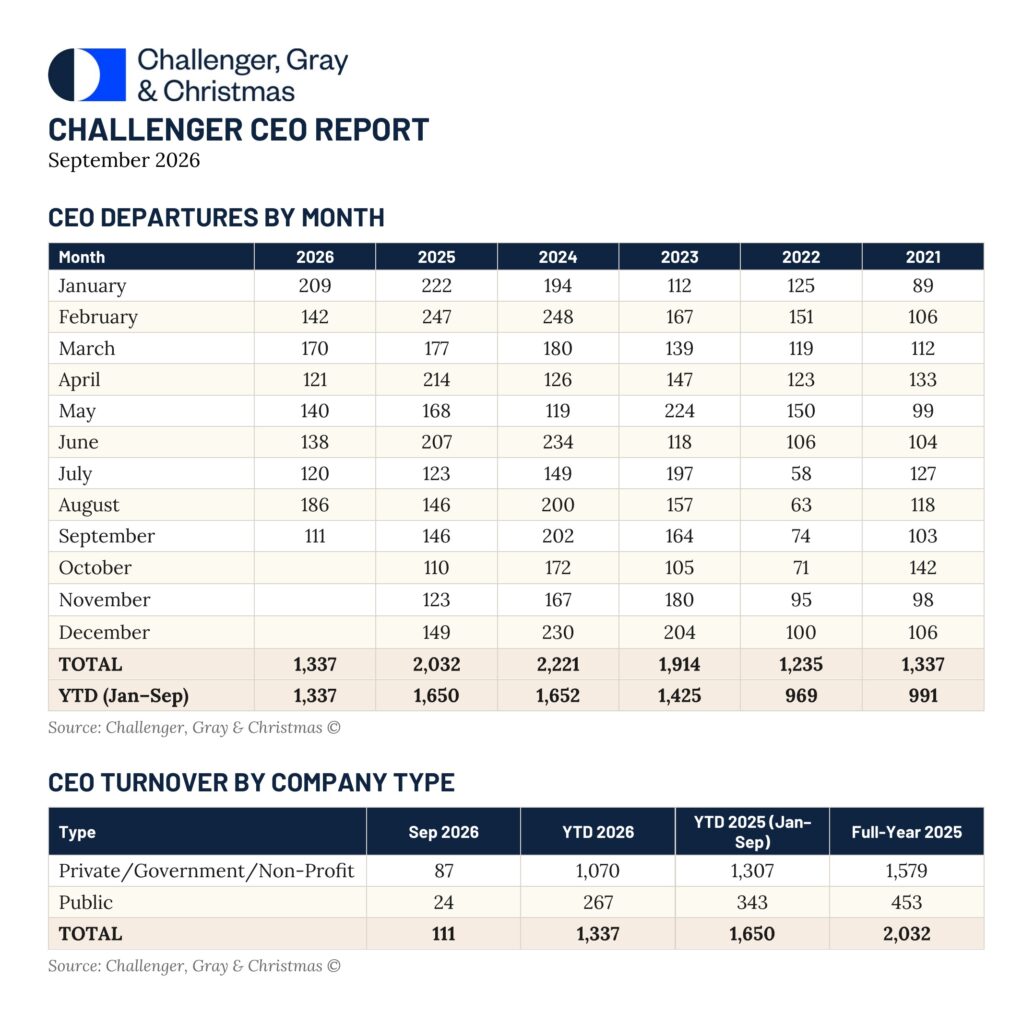
The number of CEO changes at U.S. companies fell 40% to 111 in September from 186 in August. It is down 24% from the 146 CEO exits announced in the same month one year prior, according to a report released Tuesday by global outplacement and executive coaching firm Challenger, Gray & Christmas.
September’s total is the lowest monthly count of 2026 and the lowest for the month of September since 2022, when 74 CEO exits were recorded. It is the lowest monthly total since October 2025, when 110 CEO exits were recorded.
Through the first nine months of 2026, 1,337 CEO exits have been announced, down 19% from the 1,650 recorded in the same period last year. It is the lowest year-to-date total since 2022, when 969 CEO exits were recorded through September.
“After August’s jump, September was the lightest month of the year. CEO exits are running nearly a fifth below 2025, and boards appear to be holding steady heading into the final quarter,” said Andy Challenger, labor expert and chief revenue officer for Challenger, Gray & Christmas.
“The departures we are seeing are largely planned. Step-downs and retirements made up more than half of September’s exits, and more companies are filling the seat from within,” he added.
Publicly-traded company exits held below last year’s pace. In September, 24 publicly-held company CEOs departed, down from 26 in September 2025. For the year, 267 public company CEOs left their posts, down 22% from the 343 CEO exits from public companies recorded in the same period last year.
Companies continue to promote from within. Of the 102 replacement CEOs named in September, 55 were internal hires and 47 were external. Year-to-date, 642 of the 1,214 replacements named, or 53%, came from inside the company, compared with 49% in the same period of 2025.
Women CEOs
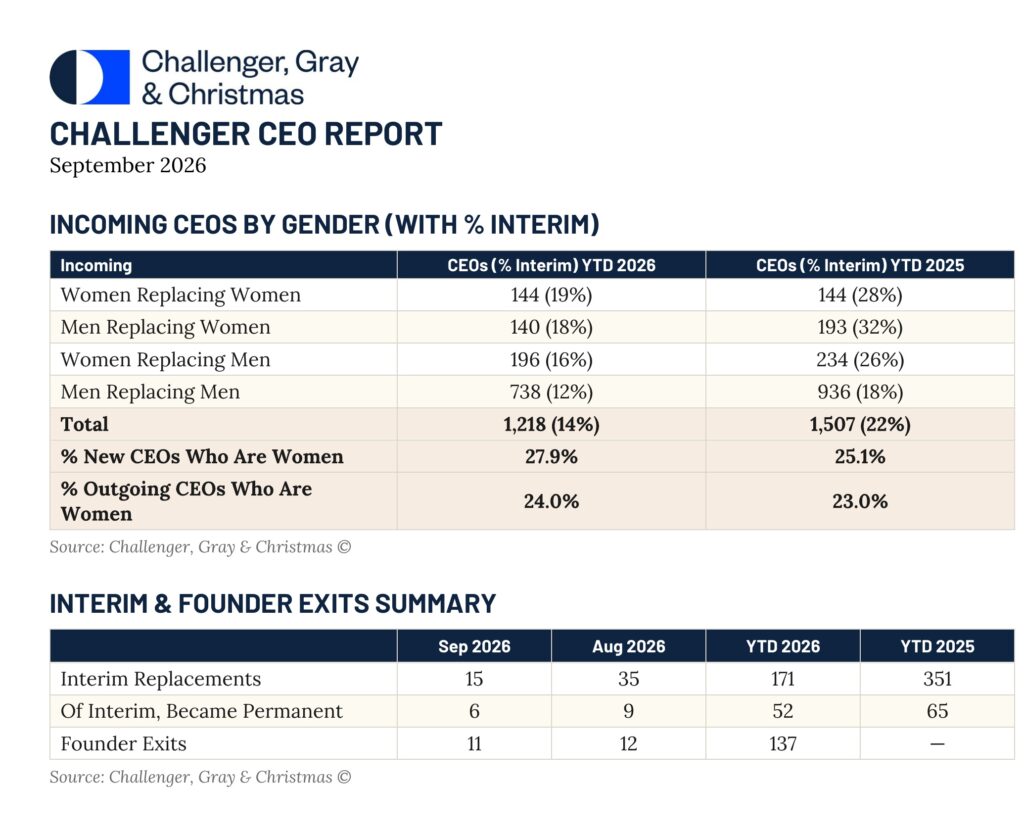
Women continue to make gains in the C-Suite. Through September, the rate of new CEOs who are women stands at 27.9% year-to-date, up from 25.1% in the same period of 2025 and above last year’s full-year rate of 25.4%. It is 0.8 percentage points below the peak of 28.7% recorded in all of 2023. In September alone, 31.4% of new CEOs were women.
Year-to-date, the rate of exiting CEOs who are women stands at 24.0%, up from 23.0% in the same period last year.
“Nearly three in ten new CEOs named this year are women, and in September it was closer to one in three. Companies that invested in their leadership pipelines are seeing it pay off,” said Challenger.
WHAT INDUSTRIES SAW EXITS IN SEPTEMBER?
Government/Non-Profit led all industries with 32 CEO exits in September, down from 62 in August and up from 25 in September 2025. Year-to-date, the sector has recorded 376 exits, the most of any industry and up 10% from the 341 recorded in the same period last year.
Hospitals followed with 13 CEO exits in September, down from 15 in August and up from 10 in September 2025. The sector has recorded 116 exits year-to-date, up 22% from 95 in the same period of 2025, one of five industries running ahead of last year’s pace.
Technology posted 9 CEO exits in September, down from 19 in August and 13 in September 2025. The sector’s year-to-date total of 135 trails last year’s 175, a 23% decline.
Consumer Products, Entertainment/Leisure, Health Care/Products, and Services each reported 7 exits in September, and Financial firms announced 6. Health Care/Products has recorded 72 exits year-to-date, down 54% from 158 a year earlier, the steepest decline among the larger sectors.
WHY DID CEOs LEAVE IN SEPTEMBER?
Stepped Down led all reasons in September with 40 CEOs leaving their roles, usually into a Board or other consulting position, followed by 20 Retirements. Together the two categories accounted for 54% of the month’s departures. Year-to-date, 380 CEOs have stepped down and 347 have retired.
CEOs who saw their interim periods end drove 14 exits in September. Year-to-date, 102 interim CEOs have exited, up 70% from 60 in the same period last year and already above the 78 recorded in all of 2025.
New Opportunities accounted for 9 September exits, Resignations for 8, and Acquisitions/Mergers for 7. “No Reason Given” accounted for 3 departures.
Other reasons for CEO departures in September include: Restructuring: 5; New Position Within Company: 2; Allegations of Professional Misconduct: 1; Death: 1; Personal Reasons: 1.
Eleven of the CEOs who departed in September were founders of the companies they led, bringing the year-to-date total of founder exits to 137.
Lorem ipsum dolor sit amet, consectetur adipiscing elit. Ut elit tellus, luctus nec ullamcorper mattis, pulvinar dapibus leo.
When careers shift, we step in.
Get started with outplacement solutions that get you where you want to go.