

Why Companies Hire Executive Coaches: The Top 5 Reasons
Publication date: Nov 16Most companies don’t bring in an executive coach to fix a struggling leader. They bring one in because a strong leader’s role has outgrown the skills that got them there, and the business can’t afford a slow adjustment.
Key Takeaways
- The five most common reasons we see in our engagements are executive presence, leadership transitions, leading leaders and delegation, stakeholder influence and emotional intelligence.
- Most requests include more than one of these. A newly promoted leader, for example, often needs presence, delegation and new stakeholder relationships at the same time.
- Each reason carries a business cost: stalled succession, failed transitions, disengaged teams, slower decisions and avoidable turnover.
- Coaching works because it’s built around one leader’s real situation, with HR and the business sponsor agreeing on what success looks like from the start.
- Strategic thinking, burnout, visibility and accountability round out the list, and they often show up alongside the top five.
It’s rarely about fixing anyone
Ask people why a company hires an executive coach, and many will guess it’s a last-ditch effort for a leader who’s in trouble. What we see in our engagements says otherwise.
When HR leaders and business sponsors come to us, they’re usually describing someone they want to keep and grow. The leader has delivered. They’ve been promoted, or they’re about to be. And the job in front of them now asks for something different from the job they mastered.
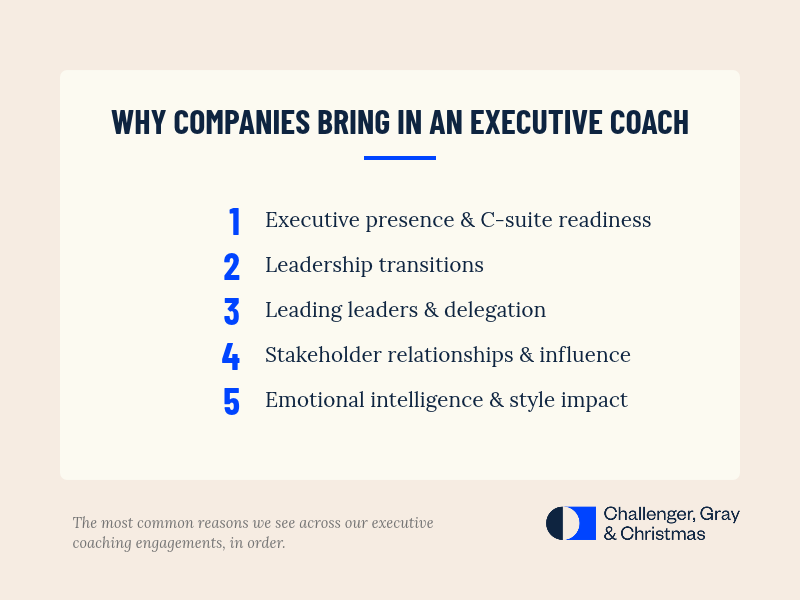
We looked at the reasons behind the executive coaching requests we receive and grouped them into nine needs. Five come up far more often than the rest. Here they are, in order, with what each one looks like, why it matters to the business and how coaching helps.
1. Executive presence: being seen as ready for the next level
Executive presence is the most common reason companies call us. It shows up in more of our executive coaching requests than any other need.
The language is consistent. Sponsors want a leader to be “more polished,” “credible with senior leadership” or “ready for the next level.” They want to know how the leader can show up with the C-suite, the board or investors.
Why it matters: Presence decides who gets trusted with scope. Coqual’s research found executive presence accounts for 26% of what it takes to get promoted. When a strong leader doesn’t read as ready, your succession bench gets thinner than it looks on paper.
How coaching helps: The coach and leader start by finding out how the leader actually lands, often through stakeholder interviews. Then they practice before the moments that count: board updates, executive meetings, tough questions. Progress shows up in how stakeholders describe the leader.
Read more: Executive Presence Coaching: How Leaders Earn the Room
2. Transitions: setting new and promoted leaders up to succeed
Transitions are close behind. Many of the executive coaching requests we receive involve one. That includes a new hire into a senior role, an internal promotion, an expanded remit or a leader who’s now managing former peers.
Why it matters: Promotions are expensive bets. McKinsey research found that 27% to 46% of executive transitions are regarded as failures or disappointments two years in. The cost isn’t just the leader. It’s the team, the strategy and the time it takes to recover.
How coaching helps: Coaching gives a new leader a confidential place to think through the first months: what to learn, who to meet, which early decisions to make and how to reset relationships with former peers. With HR and the sponsor aligned on goals, everyone can see whether the leader is gaining traction.
Read more: Executive Transition Coaching for New and Promoted Leaders
3. Leading leaders: getting out of the weeds
In many of the executive coaching requests we receive, the leader needs to shift from doing to leading through others. They’re still solving problems their team should own. They struggle to delegate, or to let others learn by trying.
Why it matters: A leader in the weeds becomes a bottleneck, and their team stops growing. Gallup found managers account for at least 70% of the variance in team engagement. For one Challenger client, coaching business unit leaders out of top-down habits helped deliver a 2% productivity gain, worth an estimated $3M in added revenue.
How coaching helps: The coach and leader look at where the leader’s time goes, decide what only they can do and build a plan to hand off the rest. They work on the conversations that make delegation stick, like setting clear expectations and checking in without taking back control.
Read more: Leading Leaders: Coaching Executives Out of the Weeds
4. Stakeholder influence: getting buy-in without authority
At senior levels, results run through people you don’t manage. A large share of the requests we receive cite stakeholder relationships and influence.
Sponsors describe peers with “big personalities,” relationships that need repair and leaders who come across as abrasive or aloof when they mean to be decisive.
Why it matters: When key relationships are strained, decisions slow down and good ideas stall. Research from the Center for Creative Leadership has long identified problems with interpersonal relationships as a leading cause of executive derailment.
How coaching helps: The coach and leader map the stakeholders who matter most, learn what each one cares about and plan how to build trust before the leader needs it. Stakeholder interviews at the start and later in the engagement show whether perceptions are shifting.
Read more: Influence Without Authority: Coaching for Senior Leaders
5. Emotional intelligence: closing the gap between intent and impact
Many requests also involve emotional intelligence, self-awareness or the way a leader’s style lands. The leader may be too direct, too intense or too informal for the room. Usually, they don’t see it.
Why it matters: Most of us overestimate how well we know ourselves. In Tasha Eurich’s research published in Harvard Business Review, 95% of people believed they were self-aware, but only 10% to 15% actually were. At the top, that blind spot affects whole teams.
How coaching helps: Assessments and stakeholder feedback give the leader a clear picture of their impact. Then the coach and leader work on a few specific behaviors, like pausing before reacting or adjusting style for different audiences, and track how others respond.
Read more: Emotional Intelligence Coaching: Closing the Impact Gap
Also on the list
Four more needs show up often, and they tend to travel with the top five:
- Strategic thinking and an enterprise mindset. Leaders who need to move from running a function to shaping the business. Strategic Thinking Coaching: Building an Enterprise Mindset
- Sustainability and burnout. High performers who are stretched too thin to keep going at this pace. Executive Burnout Coaching: Keeping Top Leaders in the Game
- Self-advocacy and visibility. Leaders whose work is stronger than their reputation. Executive Visibility Coaching: Recognition Without Politics
- Accountability and difficult conversations. Leaders who need to hold people to a standard without damaging relationships. Accountability Coaching: How Leaders Handle Hard Conversations
What the five reasons have in common
Read the list again and a pattern shows up. None of these is about a leader who can’t do the job. Each one describes a leader whose job got bigger.
That’s also why most requests include more than one need. A newly promoted leader often needs to build presence with a new set of peers, delegate work they used to own and earn trust with stakeholders they’ve never worked with. Good coaching treats those as one connected plan, not five separate problems.
And it’s why coaching tends to beat a one-size-fits-all program for these needs. A program teaches a group the same content. Coaching works on one leader’s real situation: their team, their stakeholders and the decisions on their calendar this month.
How to decide where to start
If you’re weighing coaching for a leader, a few questions can help you focus:
- What changed? A new role, a bigger team or a new boss usually points to transitions, delegation or influence.
- What are people saying? If feedback is about how the leader comes across, start with presence or emotional intelligence.
- What’s at stake for the business? Name the outcome you need, such as a successful first year, a stronger succession bench or a team that keeps its best people.
- Who needs to see the change? Bring the business sponsor in early so everyone agrees on what success looks like.
How Challenger approaches executive coaching
Executive coaching is core to what we do at Challenger, Gray & Christmas, and we’ve helped organizations through leadership and workforce change for more than 60 years.
Every engagement starts with an alignment meeting between the coach, the leader, HR and the business sponsor. Together, they agree on goals and how progress will be measured. Leaders choose from three curated coach options, each with 20+ years of executive leadership experience and accredited coaching training. Coaching is confidential, and progress is tracked through the engagement and after it ends.
The results hold up. Ninety-nine percent of clients say Challenger helped them become more effective, confident leaders, and clients see an average return of 5.7x their investment in executive coaching. We coach individual leaders and leadership teams.
Frequently asked questions
What are the most common reasons companies hire an executive coach?
In the executive coaching requests Challenger receives, the five most common reasons, in order, are executive presence and C-suite readiness, leadership transitions, leading leaders and delegation, stakeholder relationships and influence, and emotional intelligence. Most requests involve more than one.
Is executive coaching only for leaders who are struggling?
No. Most executive coaching is for strong leaders whose roles have grown. Companies use coaching to help high performers step into bigger jobs, earn credibility with senior stakeholders and lead through others. It’s an investment in leaders the company wants to keep and grow.
When is the best time to bring in an executive coach?
Coaching pays off most at moments of change: a promotion, a new senior hire, an expanded role, a reorganization or a leader preparing for succession. Starting early in a transition helps the leader build good habits before patterns set in. See The Best Times to Invest in Executive Coaching.
How do companies measure the impact of executive coaching?
Start by agreeing on goals with the leader, HR and the business sponsor. Then track observable behavior change through stakeholder feedback, along with business indicators like team engagement, retention, time-to-impact in a new role and delivery on key initiatives. Learn more in How to Measure the Impact of Executive Coaching.
Can executive coaching work for a whole leadership team?
Yes. Group coaching helps leadership teams build shared habits, especially when a team is new, newly merged or going through change. Many organizations pair group coaching for a team with 1:1 executive coaching for individual leaders.
Find the reason that fits your leaders
Every leader is different, but the reasons companies bring in a coach are remarkably consistent. If one of these five describes someone on your team, that’s usually where coaching pays off fastest.