How Outplacement Reduces Voluntary Turnover After a Layoff
Publication date: Oct 12The employees you kept are watching how you treat their friends you had to let go. Outplacement changes what they see, and what they decide to do next.
We’ve written elsewhere in this series about why layoffs increase voluntary turnover among the employees who remain. The short version: a layoff signals uncertainty, and the employees with the most options act on that signal fastest, often the very people a company can least afford to lose.
The useful follow-up question is what actually changes that signal. The research points fairly clearly at one lever: how visibly and genuinely the company supports the people it’s letting go.
KEY TAKEAWAYS
- Layoffs increase voluntary turnover among remaining employees, largely because of what the layoff signals about job security and company culture.
- That signal, not the layoff itself, is the actual mechanism driving the extra departures, which means it’s also the thing a company has the most power to influence.
- A visible, well-run outplacement program gives remaining employees concrete evidence that the company invests in people, even during hard decisions.
- This shifts the signal from ‘anyone could be next and be forgotten’ to ‘if it happens, I’ll be supported,’ which research links directly to lower flight risk.
The Signal Employees Are Actually Reading
Remaining employees aren’t primarily reacting to the fact that a layoff happened. Restructuring is a normal, expected part of business, and most employees understand that intellectually. What they’re reacting to is what the layoff reveals about how the company behaves when things get hard, because that’s the closest available preview of how they might be treated if their own role were ever eliminated.
A quiet layoff, minimal communication, no visible support for departing colleagues, tells remaining employees that an exit here is handled with silence. A visible, well-resourced transition process tells a very different story: that even in a hard moment, the company invests in getting people to their next opportunity, because that’s who the company actually is, not just a line in a values statement. Employees update their own risk assessment based on which of those two stories they just watched play out.
There’s a useful way to summarize this shift in thinking: offboarding deserves the same level of intentional design that most companies already give onboarding. Organizations invest heavily in a new hire’s first ninety days because they know that experience shapes retention for years. The exit experience shapes the retention of everyone who’s still watching, and it deserves the same deliberate attention, not an afterthought bolted onto the severance paperwork.
Putting a Number on the Retention Effect
This isn’t just a reasonable-sounding theory. Research published in the Academy of Management Journal found that companies whose employees perceived the layoff process as fair, consistent, and well communicated, saw 48% less increased voluntary turnover than companies whose employees didn’t perceive the process that way. A visible outplacement program is one of the most concrete, controllable ways a company can move itself toward the high end of that index, since it’s tangible evidence of fairness rather than a claim of it.
What Managers See That Employees Don't
There’s an internal-visibility gap worth naming directly: managers usually know a robust outplacement benefit exists, because HR walks them through it before the announcement. Their direct reports, the people actually forming opinions about company culture, often don’t, unless someone deliberately communicates it. A program a company is genuinely proud of but never actively publicizes internally captures a fraction of its available retention value, because the employees whose flight risk it’s meant to influence never actually see it in action. Sure, employees and former employees talk about their separation benefits, but when under the covers of secrecy and not in the open this leaves uncertainty and doubt as well as an uncontrolled (and not trusted) company message.
Closing that gap is mostly a communication design problem, not a program design problem: making sure the people who stay understand, concretely, what kind of support their departing colleagues are receiving, without turning the moment into a marketing exercise. Companies that do this well tend to fold it into their broader internal communication about the restructuring itself, rather than treating it as a footnote in an HR FAQ.
Why 'Visible' Matters as Much as 'Available'
It’s not enough for an outplacement benefit to exist in a policy document. Its retention value comes from being seen, colleagues can see that a departing employee is getting real support, coaching, job search resources, structured guidance, not just a check and a handshake. That visibility is what actually reaches the people still at their desks, and it’s the piece that gets lost when outplacement is treated as a quiet, optional line item rather than a core part of how the offboarding process is designed and communicated.
Remaining employees aren't evaluating whether the layoff was justified. They're evaluating what would happen to them if they were next.
The Cost of Getting the Signal Wrong
It’s worth sitting with what happens when this goes unmanaged. A company that treats outplacement as a quiet, optional add-on isn’t neutral on this front, it’s actively sending the weaker signal by default. Silence isn’t the absence of a message. To an anxious workforce watching how colleagues are treated on the way out, silence reads as confirmation of the worst assumption: that people here are replaceable, and that leaving quietly is what everyone should expect. That’s an expensive default to fall into by simply not deciding to do something different.
Where This Shows Up in Retention
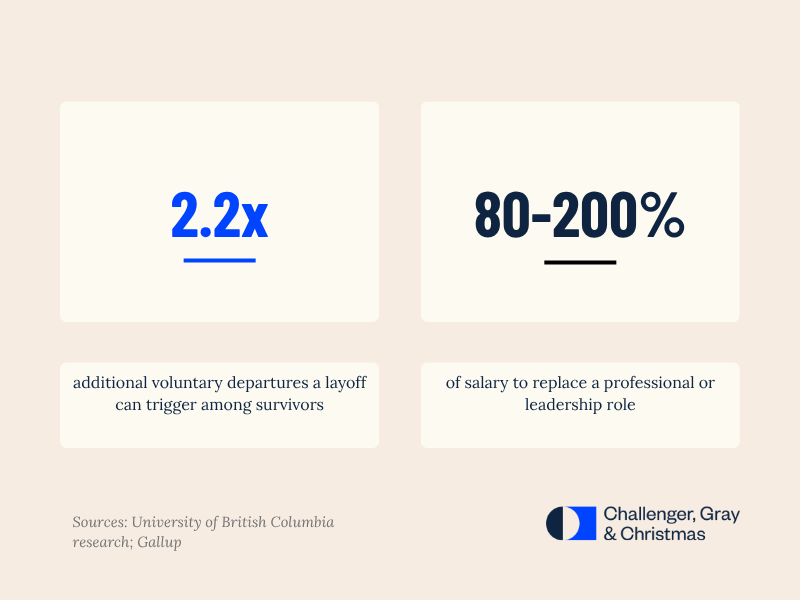
This connects directly to the replacement-cost math covered elsewhere in this series: replacing a professional role costs roughly 80% of salary, and a leadership role can run as high as 200%. Every voluntary departure a well-run transition helps prevent is a cost avoided at that scale, on top of the disruption of losing institutional knowledge during an already unstable period, and on top of the morale hit that comes with watching yet another colleague walk out the door.
The retention benefit isn’t limited to the weeks immediately following the announcement, either. Because trust rebuilds slowly, the signal sent during a layoff continues to shape engagement and flight risk for months afterward, which means the return on a well-executed transition compounds over roughly the same window the underlying turnover risk does.
Designing the Signal on Purpose
This is the piece that separates outplacement-as-checkbox from outplacement-as-strategy. A program that’s genuinely integrated into the offboarding process, communicated clearly to the whole organization, not just the departing employees, does real retention work. A program that exists quietly in an HR policy document mostly doesn’t, regardless of its quality on paper.
This is also where a one-size-fits-all program tends to fall short. A custom-fit approach, built around your industry, your team structure, and how your specific culture communicates, does more retention work than a generic package, because remaining employees can tell the difference between something built for them and something bought off a shelf.
When we work with companies on a transition, part of the conversation is specifically about this: how the program gets communicated internally, so it actually functions as the signal that keeps your best remaining people from updating their resumes. We’ve helped thousands of organizations design exactly this kind of communication plan, and our calculator can help you estimate what the retention return looks like for your specific team before you build it.
See the ROI of outplacement for your company
Want to see how a visible, well-designed transition program could affect your retention risk? Run your numbers through our calculator for a personalized report, and let’s talk through your specific plan.