
Sep 15 Recording, Transcription & AI Are Becoming the Norm in Job Interviews
How should employers and job seekers prepare?
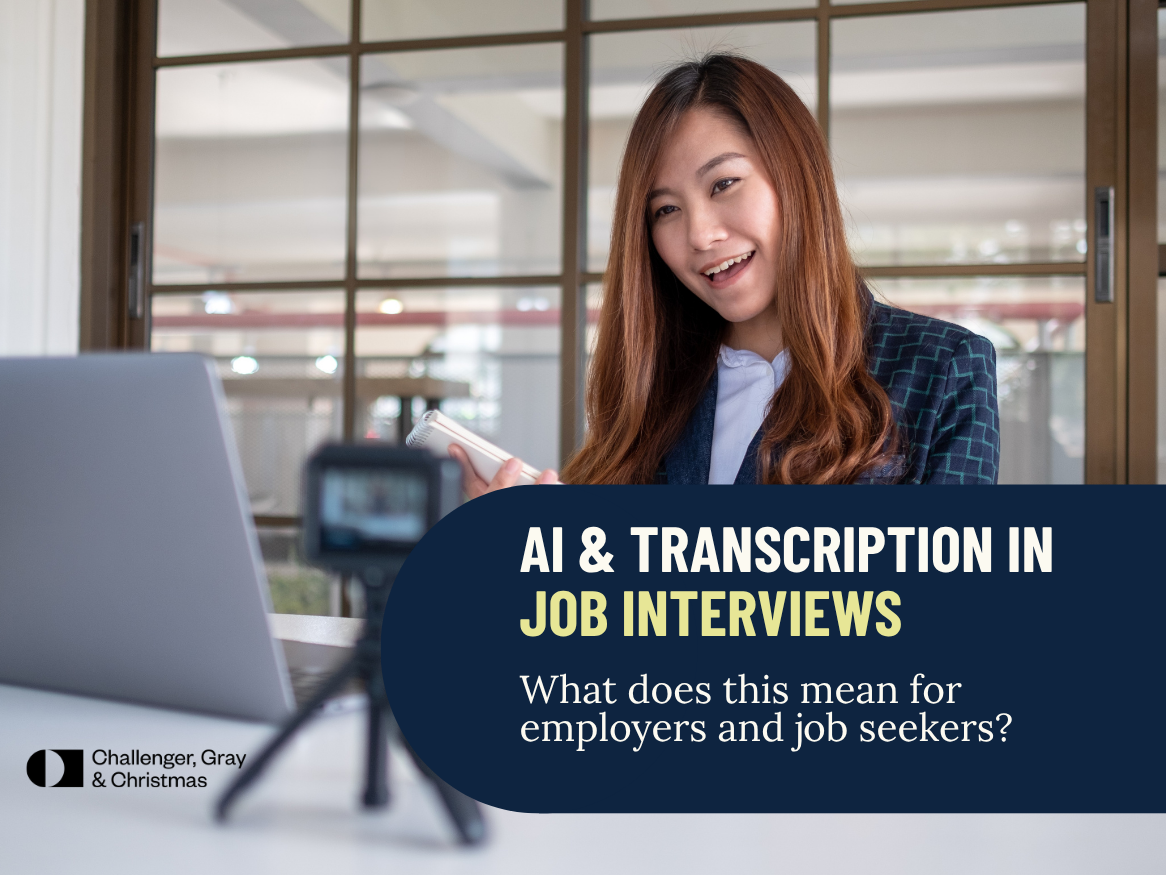
Recording, transcription, and AI-generated summaries are routine in business meetings, helping connect remote teams or loop in absent team members. However, the practice is also spreading to job interviews, changing not only how candidates are evaluated and how hiring decisions are made, but also how job seekers need to prepare for and show up to interviews, according to one workplace authority.
“The important change is not that more meetings are being recorded. Conversations that once disappeared after a meeting can now become permanent, searchable records that are stored, shared, and incorporated into other systems,” said John Challenger, Chief Executive Officer for Challenger, Gray & Christmas.
According to an April 2025 survey from TestGorilla, 70% of U.S. employers are using AI in their hiring processes. A 2025 survey by meeting software company Fellow found that 75% of professionals use AI notetakers in at least some meetings. Data on the share of companies recording interviews is elusive, but according to a 2022 Harris Poll survey, 64% of companies were employing video interviews.
“A whole host of issues can be introduced by using recording and transcription services in external-facing meetings. A job seeker’s mistake could be recorded permanently. An interviewer’s insensitive – or even illegal – question could also be captured. When recordings are involved, both the company and the job seeker need to be polished, professional, and aware,” said Challenger.
Interviews Become Searchable Records
All three of the top web conferencing platforms, Zoom, Microsoft Teams, and Google Meet, offer built-in recording, transcription, and AI-summary capabilities. Employers also use recruiting platforms that produce interview notes, populate scorecards, compare answers with job requirements, and recommend follow-up questions.
In most cases, AI is not making the final hiring decision. However, it may shape the information presented to decision-makers by determining what is highlighted, omitted, or identified as a concern.
“A hiring manager may read an AI-generated summary without watching the interview. That summary can become the initial evaluation of the candidate, even when the software is described as a notetaker. And sometimes those notetakers make mistakes,” said Challenger.
Some interview platforms claim to analyze speaking patterns, sentiment, engagement, and other behavioral signals. Claims that software can reliably determine personality, emotion, or honesty from facial expressions, eye movements, or body language remain contested, and hiring managers should not rely on them when considering a candidate, Challenger warned.
Bias in Hiring
“Typically, people hire people they like, who they click with. This can cause – and in fact, has caused – bias in hiring practices, as hiring managers tend to hire people who are very similar to themselves. In theory, this is something an AI hiring tool can mitigate, but in practice, automated and AI-screening tools show bias, as well,” said Challenger.
In fact, according to new research discussed on Stanford University’s Human-Centered AI Institute’s blog and published in the Association of Computing Machinery FAccT Proceedings, racial bias was detected in AI screening tools. Looking at 4 million applications to over 1,700 positions in more 150 companies routed through one hiring vendor, the research found, “…that 26% of Black applicants and 15% of Asian applicants applied to positions where the AI system discriminated against their racial group.”
According to the research, AI-hiring software recommended 58.2% of applicants to hiring managers, and the remaining applicants are likely rejected without a human ever reviewing their credentials.
“These findings were for AI-screening tools companies have been using for a decade, but highlights the importance of human decision-making. While AI has advanced significantly, where it is involved, it’s crucial that humans remain firmly in the loop. Multiple decision makers and HR can ensure bias in the process is eliminated as much as possible,” said Challenger.
What this means for employers
Employers have an obligation to tell candidates when an interview will be recorded or transcribed and explain whether AI will be used only to summarize the conversation or also to assist in evaluating the candidate.
They should also establish policies governing consent, access, retention, deletion, and accommodations, as well as consider privacy implications. In the Fellow survey, among active users, 47% of respondents said a notetaker had recorded or shared something they did not intend to capture. Privacy was the most frequently cited concern among non-users.
“Candidates should not have to interrupt an interview to determine how their information will be used, stored, or shared,” said Challenger.
Companies also need to consider the psychological impact of recording applicants. While recording can allow interviewers to focus on candidates rather than taking notes and permit managers who were not present to review the candidate’s answers directly, it may also cause candidates to become more guarded.
Transcription errors may distort their answers, and AI-generated summaries may omit the context or nuance of the conversation.
“Recording changes how candidates behave and how hiring teams interpret interviews. Organizations need to consider its effect on candor, fairness, and trust,” said Challenger.
What This Means for Job Seekers
Job seekers are now communicating with multiple audiences: the people conducting the interview live and the people or systems reviewing it afterward.
This makes clear and specific answers more important. Candidates should respond directly to the question, describe their individual contribution, and support their claims with examples and measurable results.
Answers should also make sense when converted into text. Vague references such as “it,” “that,” or “what we did” may be understandable during a live conversation but unclear in a transcript or summary.
Challenger advises candidates to:
- Answer the question before providing background.
- Speak in complete, concise thoughts.
- State their individual role in an accomplishment.
- Use specific examples and measurable results.
- Keep dates, responsibilities, and accomplishments consistent with the resume.
- Pause rather than filling silence or speaking over the interviewer.
- Maintain natural camera engagement without staring continuously into the lens.
- Avoid treating any part of a recorded conversation as off the record.
Candidates should prepare carefully but avoid memorizing complete responses. Overly rehearsed answers can weaken the natural exchange that helps an interviewer and other humans in the loop assess judgment, credibility, and interpersonal effectiveness.
“Candidates should be clear enough for the transcript, specific enough for the evaluation, and natural enough for the person conducting the interview and any person who is evaluating the video or transcript later,” said Challenger.
“Job seekers and employers alike need to remember that behind every transcript, summary, and score, hiring is still fundamentally a human decision. The best interviews reveal whether a candidate can work together with their teams to solve problems, and no algorithm can make that judgment for you,” said Challenger.